Introduction
When you apply for a job online, you’ll often see a note asking you to make your résumé “ATS‑friendly.” That phrase hints at a piece of technology that most hiring teams now consider indispensable: the Applicant Tracking System, or ATS. While many candidates hear rumors that an ATS automatically rejects any résumé that isn’t perfectly formatted, the reality is more nuanced. In this guide we unpack exactly what an ATS is, walk through its step‑by‑step workflow, debunk common myths, and explore the tangible benefits for both recruiters and candidates.
Defining the Applicant Tracking System
An Applicant Tracking System (ATS) is recruitment‑focused software that centralises every facet of the hiring funnel. Think of it as a specialised Customer Relationship Management (CRM) system, but instead of managing sales leads it manages job applicants. The core purpose is to collect, store, organise, and move candidates through defined stages—from the moment a job posting goes live to the final offer and, in many modern solutions, even the first day of onboarding.
The market data is striking: more than 70 % of large organisations and upwards of 90 % of Fortune 500 companies rely on an ATS to handle their hiring volume. This widespread adoption reflects the system’s ability to replace chaotic email threads and endless spreadsheet rows with a single searchable database.
Core Components and Features
Although every vendor packages its product slightly differently, most ATS platforms share a handful of essential modules:
- Job Requisition & Approval Workflow: Hiring managers submit a job request, which then travels through predefined approvals before the role is posted.
- Multi‑Channel Job Posting: One click pushes the opening to dozens of job boards, social media channels, and the company’s career site.
- Resume Ingestion & Parsing: Uploaded PDFs or Word files are turned into structured data—name, contact details, experience, education, skills—using natural language processing (NLP) engines such as Textkernel, DaXtra, or RChilli.
- Keyword Matching & Scoring: The parsed data is compared against a job‑specific keyword set. Many systems add weightings for seniority, certifications, or location to calculate a relevance score.
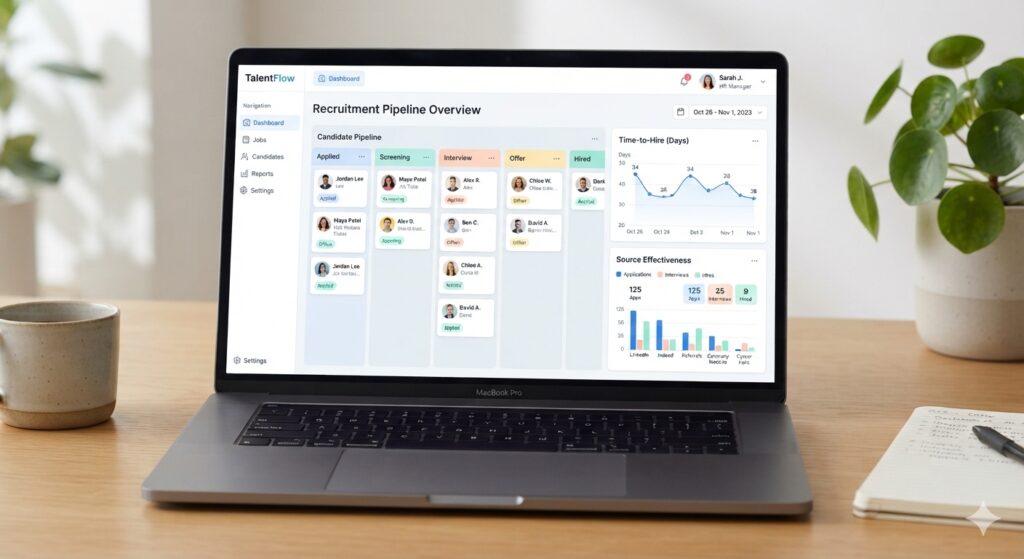
- Candidate Ranking & Shortlisting: Recruiters view a ranked list or a visual pipeline, allowing them to focus on the most promising applicants first.
- Automated Communications: Confirmation emails, status updates, interview invitations, and rejection notices are sent automatically, often with customizable templates.
- Interview Scheduling & Calendar Integration: Candidates can self‑book slots, and the ATS syncs directly with Outlook or Google Calendar.
- Analytics & Reporting: Dashboards surface metrics like time‑to‑hire, source‑of‑hire, conversion rates at each funnel stage, and diversity statistics.
- Compliance & Audit Trail: Every action—from who changed a candidate’s status to which screening question was answered—is logged for EEOC, GDPR, or OFCCP compliance.
How an ATS Works: The End‑to‑End Workflow
Below is a typical lifecycle that most ATS platforms follow. While the exact terminology can vary, the underlying steps are consistent across the industry.
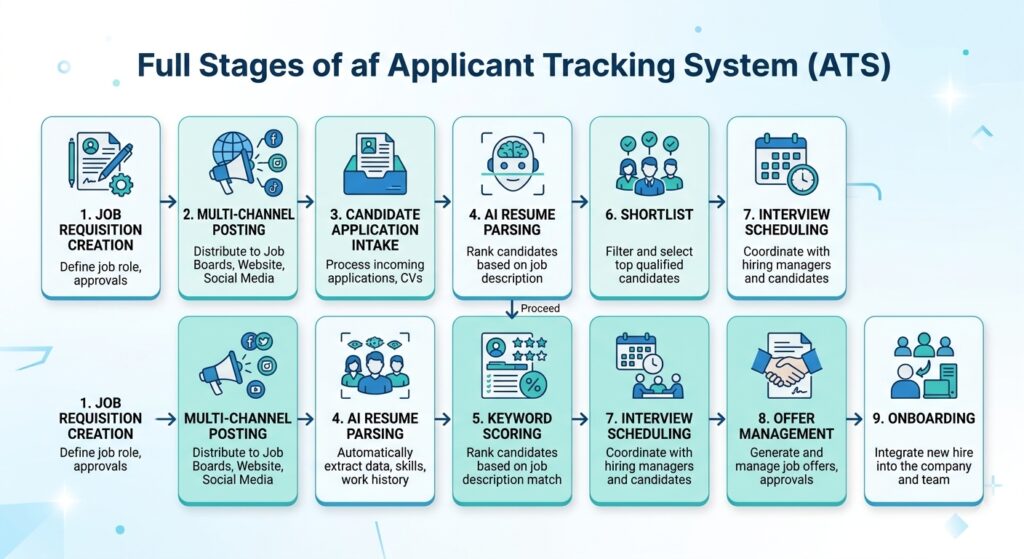
- Requisition Creation & Approval: A hiring manager drafts the role description, sets salary range, and selects required competencies. The requisition routes through an approval hierarchy, ensuring budget and policy alignment.
- Job Distribution: With the requisition approved, the ATS pushes the posting to integrated job boards (Indeed, LinkedIn, niche sites) and the company’s careers page. Some platforms also broadcast to social channels automatically.
- Application Capture: Candidates apply via the branded career portal or by uploading a résumé to a linked job board. The ATS assigns each submission a unique identifier and stores the original file.
- Resume Parsing: Using AI‑driven parsing engines, the system extracts key fields (e.g., “Software Engineer”, “Java”, “5 years”) and maps them to a structured candidate profile.
- Automated Screening: Recruiters define screening criteria—mandatory qualifications, knockout questions, or weighted keyword sets. The ATS runs each profile through these rules, generating a relevance score.
- Candidate Ranking & Shortlist: The ranked list appears in the recruiter’s dashboard. Recruiters can further filter by location, availability, or internal referral status, then move top candidates into the interview pipeline.
- Interview Coordination: The ATS sends interview invitations, lets candidates choose times, and logs each interview stage (phone screen, technical test, onsite). All notes are attached to the candidate’s record.
- Offer Management & Onboarding: Once a hire is selected, the system can generate an offer letter, capture e‑signatures, and trigger onboarding tasks in the connected HRIS.
- Analytics & Continuous Improvement: Post‑hire, the ATS records metrics such as time‑to‑fill and source quality. Recruiters use these insights to refine future job descriptions and sourcing strategies.
The Technology Behind Resume Parsing and Scoring
At the heart of every ATS is the parsing engine. Early systems relied on simple regex patterns—essentially looking for exact keyword strings. Modern solutions employ deep learning models that understand context, synonyms, and even grammar. For instance, a candidate who writes “Managed a team of 10 engineers” will be matched to the keyword “team leadership” even though the exact phrase isn’t present.
Scoring algorithms typically combine multiple factors:
- Keyword Frequency: How many times a required skill appears.
- Proximity and Placement: Skills listed under a relevant job title or in the “Core Competencies” section may carry more weight.
- Experience Level: Years of experience or seniority cues (e.g., “Senior”, “Lead”) adjust the score.
- Custom Weights: Recruiters can manually boost high‑priority qualifications (e.g., a required certification).
Because each vendor fine‑tunes its algorithm, scores can differ from one ATS to another. That’s why tools like the ATS Resume Checker are valuable for job seekers—they give a snapshot of how a typical system might evaluate a résumé and suggest keyword adjustments.
Common Misconceptions
There’s a lot of misinformation floating around the job‑search community. Let’s address the most persistent myths:
- Myth 1: The ATS automatically rejects my résumé if the formatting is off. In reality, most systems do not discard a resume solely for style. They may struggle to parse complex layouts (tables, graphics, headers), which can result in missing data, but the candidate usually remains in the pipeline.
- Myth 2: An ATS decides who gets hired. The ATS is a decision‑support tool. Human recruiters still review the shortlist, conduct interviews, and make the final offer.
- Myth 3: Using keyword‑stuffed résumés guarantees an interview. Over‑optimisation can look unnatural to a recruiter and may even trigger a low relevance score if the system detects mismatched context.
- Myth 4: All ATS platforms function the same way. Features differ dramatically—some provide AI‑driven predictive analytics, others focus on simple workflow automation. Choosing the right tool depends on company size, hiring volume, and specific compliance needs.
Benefits for Recruiters and Hiring Teams
When deployed correctly, an ATS delivers concrete ROI:
- Reduced Time‑to‑Hire: Automated parsing turns a 30‑second manual skim into a 1‑minute data entry, and ranking surfaces top talent quickly. Studies report up to a 60 % reduction in screening time.
- Lower Cost‑Per‑Hire: By cutting manual effort and agency reliance, organisations save 30‑50 % on recruiting budgets.
- Improved Candidate Experience: Timely status emails and self‑service scheduling reduce ghosting and keep applicants engaged.
- Data‑Driven Decisions: Real‑time dashboards let hiring managers see which sources deliver the best hires, enabling smarter spend allocation.
- Compliance Assurance: Automated audit trails and EEOC‑ready reporting protect against legal exposure.
Optimising Your Résumé for the ATS
Even though the ATS isn’t a mystical gatekeeper, aligning your résumé with its expectations boosts visibility. Here are actionable tips, many of which are reinforced by the How ATS Systems Actually Score Resumes guide:
- Use Simple Formatting: Stick to standard headings (Experience, Education, Skills), avoid tables, graphics, and custom fonts. A clean .docx or PDF ensures accurate parsing.
- Mirror Job Description Language: Pull exact phrases and required skills from the posting. If the role calls for “Python” and “Agile methodology,” include those terms verbatim.
- Prioritise Relevant Keywords Early: Place core competencies in the top half of the document; many parsers give higher weight to early content.
- Leverage Online Scanners: Run your résumé through the Free Resume Scanner or the AI Resume Scanner to see a breakdown of keyword matches and parsing accuracy.
- Tailor for Each Application: Even small tweaks—re‑ordering bullet points, swapping out less‑relevant skills—can increase your ATS score dramatically. Our step‑by‑step guide on how to tailor a résumé for each job walks you through the process.
Future Trends: AI, Predictive Hiring and Bias Reduction
The next generation of ATS platforms is moving beyond keyword matching toward holistic, AI‑powered talent intelligence. Emerging capabilities include:
- Semantic Matching: Using large language models to understand the intent behind experience descriptions, not just exact words.
- Predictive Analytics: Forecasting candidate success based on historical hiring data, performance reviews, and turnover patterns.
- Bias Mitigation Tools: Algorithms that anonymise identifiable information (gender, age, ethnicity) during the initial screen to promote diversity.
- Conversational Recruiters: Integrated chatbots that conduct screening questions, answer candidate FAQs, and schedule interviews in real time.
- Integrated Onboarding: Seamless hand‑off to HRIS systems for background checks, e‑signatures, and first‑day paperwork.
While AI adds sophistication, the fundamental principle remains unchanged: the ATS is a facilitator, not a decision‑maker. Human judgment, cultural fit, and soft‑skill assessment still carry the final weight.
Conclusion
An Applicant Tracking System is far more than a résumé‑filtering black box. It is a comprehensive, data‑rich platform that centralises job postings, parses applications, ranks candidates, automates communication, and delivers actionable insights. By understanding how the ATS processes information—and by optimising your résumé accordingly—you can dramatically improve your chances of moving beyond the initial screen.
For recruiters, embracing the full suite of ATS features—from analytics dashboards to AI‑driven matching—means faster hires, lower costs, and a more consistent candidate experience. For job seekers, a few simple formatting tweaks and keyword alignments—verified with tools like the ATS Resume Checker—can turn a generic application into a targeted, searchable profile that stands out in the digital filing cabinet of modern hiring.
Whether you’re a hiring manager looking to streamline your team’s workflow, or a candidate aiming to crack the system’s code, the key takeaway is the same: the ATS is a powerful ally when used wisely, not an impenetrable barrier.