Not sure why your resume keeps getting rejected? An ATS resume
checker shows you exactly how your resume scores against a job
description — before a recruiter ever sees it.
What Is an ATS Resume Checker?
An ATS resume checker is a tool that simulates how an Applicant
Tracking System reads and scores your resume against a specific
job description.
When you apply for a job online, your resume goes through an ATS
before any human sees it. The system parses your document,
extracts keywords, and scores how well your resume matches the
job description. Only applications above a certain score get
reviewed by a recruiter.
An ATS resume checker replicates that process so you can see
your score before you submit — and fix what is holding you back.
Why Your Resume Gets Rejected Before Anyone Reads It
Most candidates assume resume rejection means a recruiter read
their resume and decided they were not a fit. In most cases
that is not what happened.
Over 90% of large companies use an ATS to filter applications.
If your resume does not score above the threshold for a specific
role, it is automatically deprioritized — and the recruiter
never sees it at all.
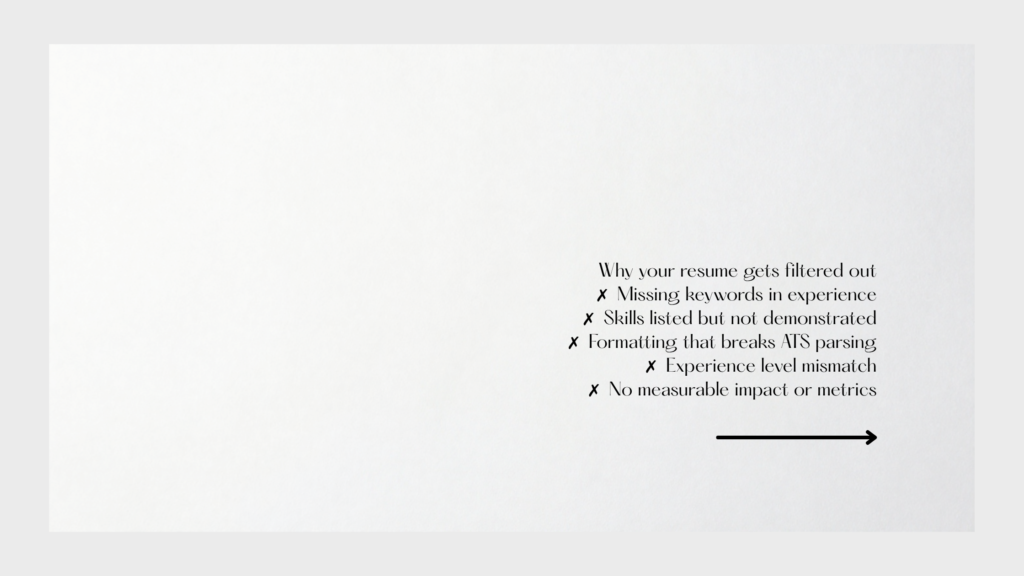
The reasons resumes score poorly are consistent:
- Missing keywords — the core skills from the job description do not appear in your experience bullets
- Keywords in the wrong place — listing skills in a skills section only gives 50% credit versus using them in experience context
- Formatting that breaks parsing — tables, columns, headers, and graphics that look fine to humans but confuse ATS parsing
- Experience mismatch — applying for a senior role with junior-level language, or missing the years of experience the JD requires
- No measurable impact — responsibility-only bullets with no outcomes or metrics
An ATS resume checker identifies exactly which of these problems
your resume has — for this specific job description, not in
general.
What Our ATS Resume Checker Checks
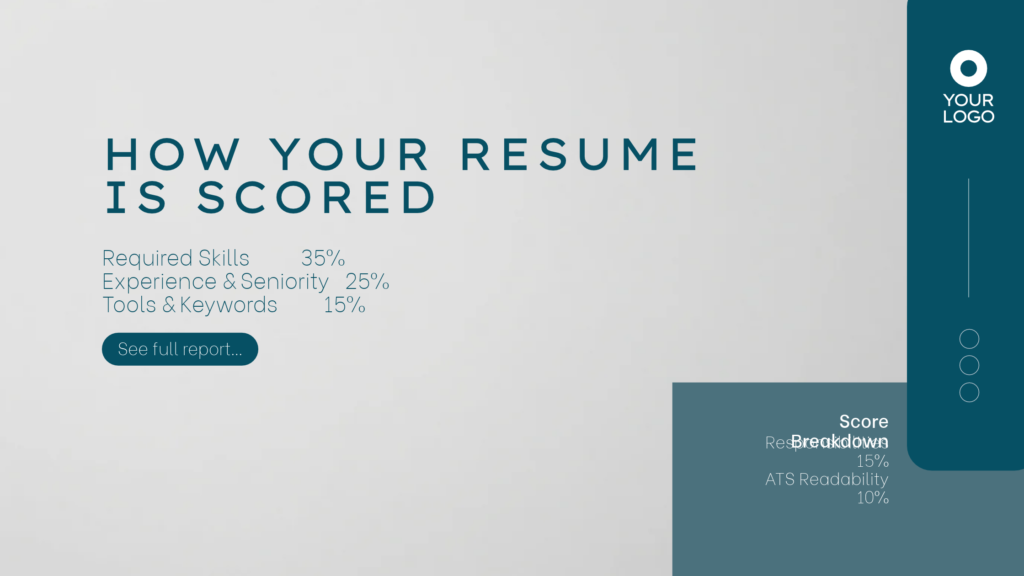
MyResumeScan evaluates your resume across five categories and produces a score for each:
Required Skills Match (35%)
The largest single factor. Compares the core technical skills,
tools, and competencies listed as required in the job description
against what appears in your resume — with context. A skill
listed only in your skills section scores lower than the same
skill described in an experience bullet.
Experience and Seniority (25%)
Checks how many years of relevant experience you have shown,
whether your job titles align with the seniority level of the
role, and whether your career progression matches what the
employer expects.
Tools, Technologies and Keywords (15%)
Beyond core skills, this covers specific tools, platforms,
certifications, and technologies the job description mentions.
Exact terminology matters — “container orchestration” scores
lower than “Kubernetes” if the JD specifically says Kubernetes.
Responsibilities and Impact Alignment (15%)
Checks whether your experience bullets describe work similar
to what the role requires, and whether that work includes
outcomes and metrics rather than just responsibilities.
ATS Readability (10%)
Evaluates how cleanly the ATS can parse your resume — section
headings, formatting, structure, and whether content is
organized in a way the system can correctly categorize.
How to Use the ATS Resume Checker
Using the checker takes less than two minutes:
- Step 1 — Upload or paste your resume text
- Step 2 — Paste the job description you are applying for
- Step 3 — Get your ATS score, subscore breakdown, missing keywords, and specific recommendations
The results tell you exactly what to fix — not general advice,
but specific gaps tied to this job description. Fix the gaps,
re-scan, and submit with confidence.
What a Good ATS Score Looks Like
ATS scores are not pass or fail — they exist on a spectrum.
Here is how to interpret yours:
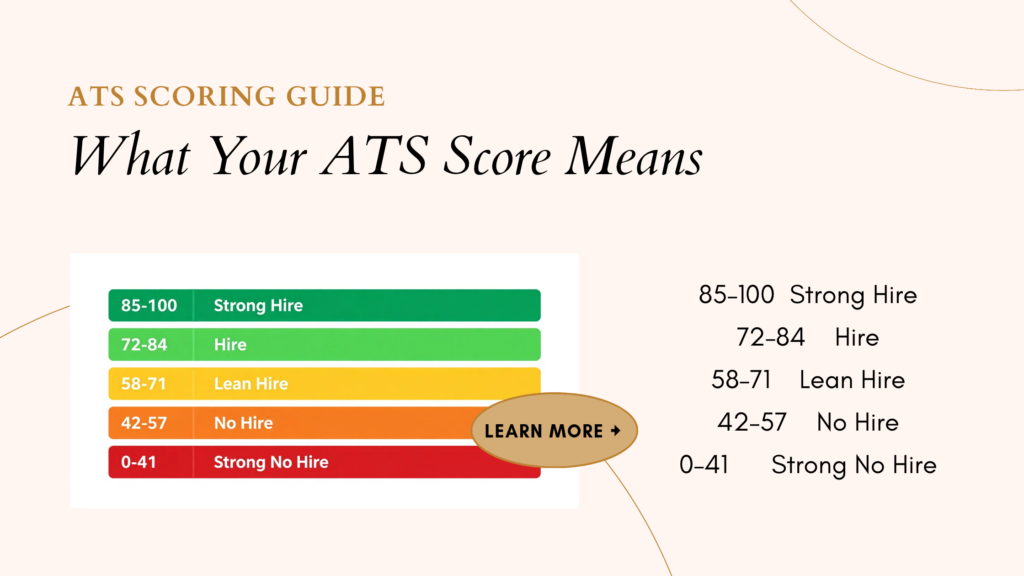
- 85–100 — Strong Hire signal. Your resume is tightly aligned with this job description. You are likely to be reviewed.
- 72–84 — Hire signal. Strong match. Minor gaps may exist but your application is competitive.
- 58–71 — Lean Hire. Some alignment but meaningful gaps. Worth improving before submitting.
- 42–57 — No Hire signal. Significant gaps between your resume and the JD. Submitting without changes is unlikely to result in a callback.
- Below 42 — Strong No Hire. Major mismatch. Either the role is not the right fit or the resume needs substantial work before applying.
A score below 65 is worth improving before you submit. The
difference between a 55 and a 75 is often three or four
targeted edits to your experience bullets — not a full resume
rewrite.
ATS Resume Checker vs Generic Resume Checker
Most free resume checkers on the internet check your resume
in isolation — they look for formatting issues, length,
action verbs, and general readability.
That is useful but incomplete. An ATS does not score your
resume in isolation. It scores it against a specific job
description. A resume that checks every general best-practice
box can still score 40 against a specific JD if the
terminology does not match.
The difference with an ATS resume checker:
- You provide the job description — the score is specific to that role, not generic
- Missing keywords are extracted from the actual JD — not a generic list of “good resume words”
- The hire recommendation reflects fit for this role specifically
- Fixing the gaps moves your score for this application — not just makes your resume look better in general
Common Questions About ATS Resume Checkers
Is the ATS resume checker free?
Yes. You can scan your resume against any job description
for free at
myresumescan.com/ats-resume-checker with no account
required.
Does it work for all job types?
Yes. The checker works for any role that has a job
description. The analysis is driven by the JD you provide —
so it works equally well for software engineering, marketing,
finance, operations, or any other field.
Will using a checker guarantee I get an interview?
No tool can guarantee an interview. What the checker does
is remove a preventable barrier — a low ATS score that
filters out your application before a human sees it. If
your experience genuinely matches the role, the checker
helps make sure your resume reflects that match clearly.
Should I tailor my resume for every job?
Yes. A resume tailored to a specific job description will
consistently score higher than a generic one for the same
candidate. The checker makes tailoring faster by showing
you exactly which gaps to fix rather than requiring you
to guess. Read our full guide on
how to tailor your resume for each job application.
What file formats does it accept?
You can upload PDF, DOCX, or TXT files, or paste your
resume text directly.
Who Should Use an ATS Resume Checker
- Active job seekers applying to multiple roles who want to maximize their callback rate
- Professionals re-entering the job market after a gap who are not sure how their resume reads to modern ATS systems
- Recent graduates applying for their first role who have not been through an ATS-heavy hiring process before
- Career changers moving into a new field who need to understand how their existing experience translates against new JD requirements
- Anyone who has been applying without callbacks and cannot figure out why
Check Your Resume Now
Paste your resume and the job description you are applying
for. Get your ATS score, see exactly what is missing, and
fix it before you submit.